
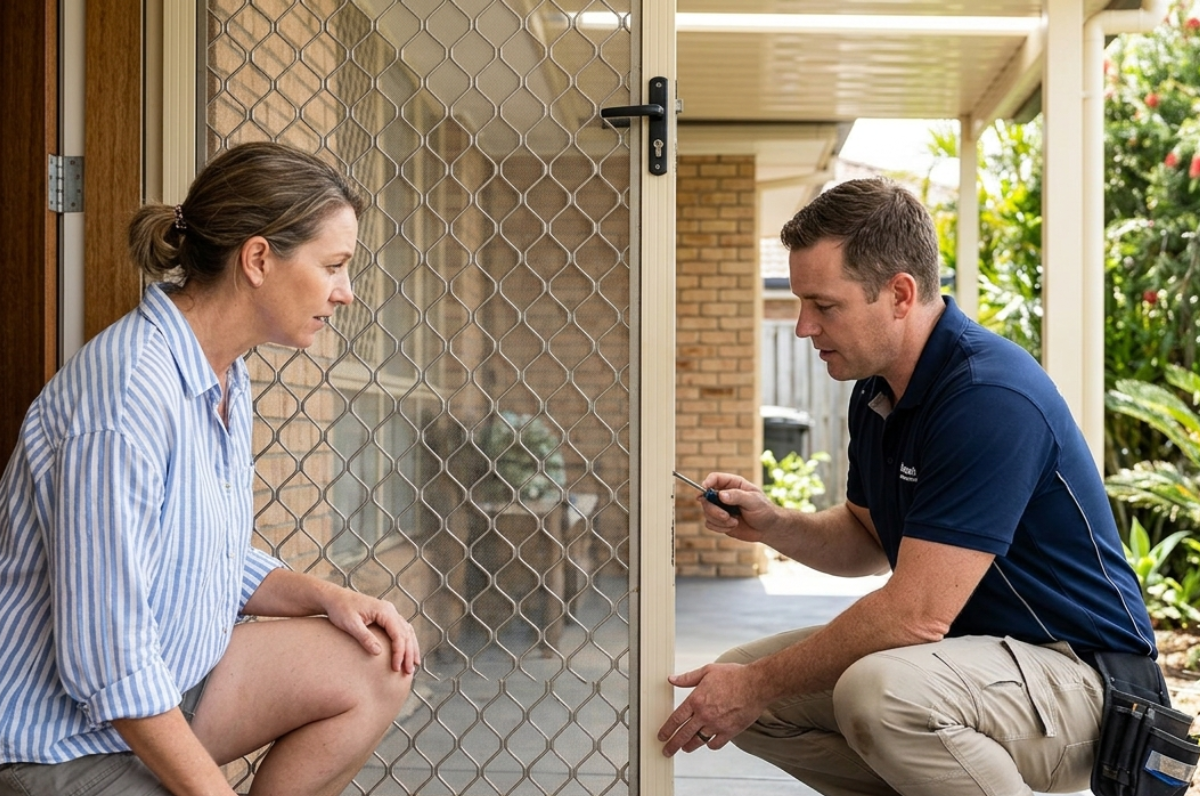
Something has gone wrong with a screen. A door drags on its hinge. Mesh has started to bubble at the corner. A lock will not turn without a shove. And now you are trying to work out whether this is a fifty dollar problem or a five thousand dollar one.
The security screen repair or replace decision is one of the more annoying calls a homeowner has to make, because the cheap option is genuinely right some of the time. Not every worn screen needs replacing. But plenty of screens get patched three times before their owner accepts they should have been replaced at the first sign of trouble.
This guide gives you a way to diagnose what you are looking at, understand what Brisbane’s climate does to screens over time, and know when a repair is good value versus when it is money you will spend again in eighteen months.
Signs Your Security Screens Are Nearing the End of Their Life
Screens rarely fail suddenly. They decline, and the early signals are easy to dismiss.
Walk your house and look for these:
On the mesh:
- Rust spots, particularly at the edges where the mesh meets the frame
- A chalky white powder on the mesh or frame, which is oxidation
- Sagging, waviness or a section that has lost its tension
- Holes, snags or a mesh that gives noticeably when you press it
- Mesh lifting or pulling away from the frame edge
On the frame:
- Corners that have opened up, leaving a visible gap
- Bowing along the long edge of a door
- Faded, chalking or flaking powder coat
- Corrosion where an aluminium frame meets a steel fixing or a different metal
On the hardware and operation:
- A door that scrapes the threshold or does not sit square in the opening
- A lock or latch that needs to be lifted, pushed or wiggled to engage
- Hinges that have dropped or screws that will no longer bite
- A closer that slams or no longer pulls the door shut
- Rattling in wind, which usually means the frame is no longer tight to the reveal
On the installation:
- Screws you can turn by hand
- Gaps between the frame and the wall where sealant has perished
- A screen you could lever at the edge with moderate force
Here is the important part. Mesh and frame problems are usually structural, which points towards replacement. Hardware and adjustment problems are usually serviceable, which points towards repair. That single distinction resolves most cases.
The one that should always concern you: if a screen no longer resists a firm pull at the edge, it has stopped being a security product regardless of how it looks.
Problems Worth Repairing Versus Damage That Means Replacement
This is the decision framework. Most situations fall clearly into one column or the other.
Usually worth repairing:
- Lock, latch or handle failure. Hardware is a consumable. Replacing a lock on an otherwise sound door is straightforward and good value.
- Hinge wear or a dropped door. Rehanging and adjusting a door that is otherwise square is routine.
- A failed door closer. Cheap to replace, and worth doing before the slamming damages the frame.
- Perished seals or brush strips. Low cost, improves weather performance and reduces rattle.
- Loose fixings or a frame that has worked loose from the reveal. Refixing and resealing is a short job.
- Cosmetic marks on a structurally sound screen. Cleaning and touch-up beats replacement.
- A single damaged screen in an otherwise healthy set. Replace the one, not the house.
Usually means replacement:
- Corroded mesh. Rust does not stop. Once it is through the mesh, the security performance is gone and no repair restores it.
- Mesh detaching from the frame. In systems where the mesh is bonded or crimped in, this is not reliably repairable. The mesh-to-frame connection is the entire security mechanism.
- A distorted or bowed frame. A frame that has lost its geometry will not hold a screen square again.
- Failed corner joints. Once corners open, the frame flexes and everything else follows.
- Prior forced entry damage. Even if it looks superficial, the system has been stressed and should be assessed properly.
- Multiple simultaneous problems on the same screen. Three repairs on one unit almost always costs more than replacing it.
- Screens that no longer meet current standards. Older products may not have been tested to the requirements now applied to security screens.
- A screen that is genuinely a flyscreen. Plenty of homeowners discover their “security screen” is a fly mesh in a light frame. There is nothing to repair, because there was never security there.
The rule of thumb worth remembering: if the repair cost approaches half the replacement cost, or if the problem is in the mesh or the frame rather than the hardware, replace it.
How Long Security Screens Should Actually Last in Brisbane’s Climate
Manufacturers quote lifespans in ideal conditions. Brisbane is not ideal conditions.
What the local climate does to screens:
- Humidity accelerates corrosion, especially at any point where two different metals meet.
- UV intensity degrades powder coating, seals, brush strips and any plastic component faster than in southern states.
- Heavy summer storms drive water into frames and reveals, and wind loads flex doors and larger panels.
- Salt air is the single biggest factor in bayside and coastal suburbs, covered in the next section.
- Big temperature swings cause expansion and contraction that gradually works fixings loose.
Realistic Brisbane lifespans, assuming reasonable installation:
- Quality stainless steel mesh screens, properly installed and occasionally rinsed: decades. These are a once-in-a-house-lifetime purchase in most inland suburbs.
- Aluminium mesh or diamond grille screens: noticeably shorter, and the decline is usually visible well before failure.
- Budget or unbranded screens: frequently show their age within the first decade, particularly the coating and hardware.
- Hardware and consumables on any system: locks, closers, hinges and seals will need servicing or replacing well before the screen itself does.
Two factors matter more than the brand on the sticker:
- Installation quality. A premium screen fitted badly fails early. AS 5040 exists because installation determines real-world performance.
- Rinsing. A hose down a few times a year, more often near the water, dramatically extends mesh life. It is the highest return maintenance task in the entire house.
If your screens are inland, stainless steel, well installed and you are seeing failure inside ten years, something went wrong at installation or the product was not what you were told it was.
Corrosion, Salt Air and Coastal Suburbs: When Screens Fail Early
If you are in Redland Bay, Victoria Point, Cleveland, Wynnum, Manly, Sandgate, Brighton, Scarborough or anywhere with a sea breeze, your screens are on a different clock.
Salt-laden air deposits chloride on every surface. Chloride breaks down the passive layer that protects stainless steel and attacks aluminium at any weak point in the coating. The process is invisible until it is not.
What early coastal failure looks like:
- Tea-coloured staining on the mesh, which is surface tea staining rather than structural rust
- Pitting, which is small dark points in the metal and is more serious
- White powdery deposits on aluminium frames
- Corrosion concentrated around screws, rivets and hinges where metals meet
- Deterioration on the seaward-facing elevation while the sheltered side looks fine
Tea staining versus real corrosion. This distinction saves a lot of unnecessary replacement. Tea staining is a cosmetic surface discolouration on stainless steel that does not compromise strength, and it usually cleans off. Pitting and flaking are structural and do not. If you cannot tell the difference, that is a reason to get it assessed rather than guessed.
What actually helps in coastal suburbs:
- Rinse with fresh water monthly. In an exposed bayside position this is the difference between fifteen years and thirty.
- Watch the fixings. Corrosion at a screw or hinge will take the screen down long before the mesh fails.
- Do not mix metals. Galvanic corrosion at a dissimilar metal contact point is a common cause of premature coastal failure.
The practical implication for the repair or replace decision: coastal screens with structural pitting should be replaced rather than patched, because the same environment that caused the first failure is still there.
What Repairs Typically Cost Compared to a Full Replacement
We are deliberately not publishing dollar figures here, because a number that is wrong for your situation is worse than no number. Screen pricing varies enormously with size, configuration, access, mesh specification and how much remedial work the opening needs. Anyone quoting you a firm price without seeing the job is guessing.
What we can give you is the shape of the costs, which is what you actually need to make the decision.
The cost tiers, from smallest to largest:
- Hardware only. Replacing a lock, latch, closer or set of hinges. The smallest spend by a wide margin, and often the right answer.
- Adjustment and refixing. Rehanging a door, resecuring a frame, replacing seals. Still modest, usually a single short visit.
- Remeshing or panel replacement, where the system allows it. A meaningful step up, and this is where systems differ. Some are designed for it, many are not.
- Single screen or door replacement. A significant jump, but contained to one opening.
- Whole house replacement. The largest number, but the lowest cost per opening because measure, travel and install are shared across the job.
The four rules that should drive your decision:
- The half rule. If a repair costs more than about half of replacing that unit, replace it. You are buying a fraction of the remaining life for most of the money.
- Watch the per-opening economics. Replacing five screens in one visit costs considerably less per screen than replacing them one at a time over five years. If several are ageing together, doing them together is cheaper.
- Count the repeat repairs. Two callouts on the same screen in two years is the market telling you something.
- Price the remaining life, not the fix. A repair that buys three more years on a twenty year old screen is not comparable to a replacement that buys decades.
A common false economy. Homeowners often repair the worst screen and leave the rest. If all the screens went in at the same time, they are all at the same point in their life. You will be back for the next one within a year or two, paying a fresh callout each time.
Why Old Grille and Diamond Grille Screens Are Rarely Worth Saving
If your screens are aluminium diamond grille, decorative cast panels or barred grilles, the repair conversation is usually short.
The structural issue. Diamond grille is typically extruded aluminium in a pressed pattern. Aluminium is soft. The security value comes from the pattern making a hole awkward to make, not from the material resisting force. Modern security screens work on a fundamentally different principle: high tensile stainless steel mesh mechanically clamped into a frame, tested against impact, knife shear, jemmy and pull.
The practical issues stack up:
- Vision and light. Grille screens obstruct the view in a way woven mesh does not. This is the thing homeowners notice most after upgrading.
- Airflow. Solid grille patterns restrict ventilation, which matters in a Brisbane summer.
- Parts availability. Many older grille systems are discontinued. Matching a panel or sourcing hardware ranges from difficult to impossible.
- Standards. Products from earlier decades were not necessarily tested to the requirements now applied to security screen doors and window grilles.
- Appearance. Grille screens visually date a house more than almost any other exterior element. This shows up at sale time.
- Cost of repair versus value gained. Spending real money to extend the life of a product that was never especially strong is poor value.
The honest exception. Decorative cast aluminium panels on a period Queenslander sometimes have heritage or aesthetic value the owner wants to keep. That is a legitimate reason to repair rather than replace, but be clear that you are preserving a look and not maintaining a security product. If security matters at that opening, the usual answer is to keep the decorative element where it is visible and add genuine security where it counts.
Can You Repair Another Brand’s Screens or Must You Replace the System?
This is the question most installers dodge, so here is a straight answer.
What is generally serviceable regardless of brand:
Hardware is largely universal. Locks, latches, handles, hinges, closers and seals can often be replaced on almost any door, because these components are made to common sizes and patterns. If your problem is that a handle has snapped or a door will not close properly, brand is mostly irrelevant.
What is generally not transferable between systems:
The mesh-to-frame connection is proprietary. Different manufacturers use different methods: some clamp the mesh mechanically, some crimp it, some bond it with adhesive. The clamping method is the security system. You cannot take mesh from one system and fit it to another frame, and remeshing a frame not designed to be remeshed does not restore its tested performance.
Frame extrusions are also brand specific. Profiles, screw ports and corner assemblies differ, so a replacement stile or rail from one brand will not fit another.
What this means for you in practice:
- A hardware fault on any brand of screen is usually a repair job, and a competent installer can often help.
- A mesh or frame fault on a system that is discontinued or not designed to be remeshed is a replacement, whatever brand it is.
- Mixing components across systems voids warranties and, more importantly, means the assembled screen is no longer the product that was tested to the standard.
- Beware anyone offering to “just remesh” a screen from a system that was not built for it. The result may look fine and perform nothing like the original.
Where Securelux fits. We are a licensed Crimsafe installer, which means genuine Crimsafe products, genuine components and installation by our own employees. If you have an existing screen of another brand and you are not sure whether it is worth saving, call us and describe the problem. We will tell you honestly whether it sounds like a hardware fix worth chasing or a system at the end of its life, and we would rather point you in the right direction than sell you something you do not need.
What Happens to Your Old Screens When They Come Off
If you do replace, the old screens do not go to landfill.
Securelux responsibly recycles all removed screens and offcuts. Security screens are unusually well suited to it, because they are made almost entirely of two highly recyclable materials.
What gets recovered:
- Aluminium frames. Aluminium is infinitely recyclable and recycling it uses a small fraction of the energy required to produce new metal.
- Stainless steel mesh. Recovered as scrap steel and reprocessed.
- Hardware. Locks, hinges and closers are metal and go the same way.
What you do not have to deal with:
- No skip bin on your driveway
- No trips to a transfer station
- No disposal fee buried in the quote
- No sharp offcuts left in the garden
We take the old screens away as part of the installation, and offcuts from the job go the same way.
There is a longer-term point here too. The most environmentally sound screen is the one you only buy once. A stainless steel mesh system built to last decades produces far less waste over the life of a house than three cycles of a cheaper product. When you weigh a repair against a replacement, the durability of what you install next is part of the environmental maths, not just the financial one.
Getting an Honest Assessment Before You Spend Anything
You should not have to guess at any of this. The whole repair or replace question resolves quickly once someone competent has looked at the actual screen.
What a proper assessment covers:
- Every screen, not just the failed one. If they were all installed together, they are all at the same point in their life. You need to know that before you spend.
- Mesh condition and, critically, mesh-to-frame integrity. This is where security actually lives.
- Frame geometry and corner joints. Is it still square, and are the joints sound?
- Fixings and the installation itself. Plenty of screens fail at the wall, not in the product.
- Hardware function. Every lock, hinge, latch and closer tested by hand.
- Identifying the system. Knowing what you have determines what can be done with it.
- A clear recommendation per opening. Repair this one, replace that one, leave the other three alone.
Questions worth asking whoever assesses your screens:
- Is this problem in the hardware, the mesh, the frame or the installation?
- Is this system designed to be remeshed?
- If you repair it, how long would you expect that to last?
- Which of my screens can wait, and which cannot?
- Is anything here no longer providing genuine security?
What should make you cautious. A quote to replace everything without a walkthrough. A refusal to identify what is repairable. Pressure to decide on the spot. Any answer that does not distinguish between a cosmetic problem and a structural one.
Our consultations are free and carry no obligation. We would rather tell you that four of your screens have years left in them than sell you a job you did not need, because the honest assessment is what earns the referral.
Repair and Replacement Questions From Brisbane Homeowners
How do I know if my security screen is still actually secure? Test it by hand. Press the mesh firmly and pull at the edge where the mesh meets the frame. Movement, give or any sign that the mesh could separate from the frame means the security function is compromised. Rust through the mesh, opened corner joints and fixings you can turn by hand are all serious. Cosmetic fading and surface marks are not.
Can rusty security screen mesh be repaired? No. Corrosion removes material and does not stop progressing. Surface tea staining on stainless steel is different and usually cleans off without affecting strength, but genuine rust through the mesh means that screen needs replacing.
Is it cheaper to replace all my screens at once or one at a time? Almost always cheaper per screen to do them together, because measure, travel and installation time are shared across the job. If several screens went in at the same time and are all showing age, doing them in one go is generally better value than three separate visits over five years.
Can you repair a security screen from another brand? Hardware faults such as locks, hinges, handles and closers are often serviceable on any brand. Mesh and frame faults usually are not, because the mesh-to-frame clamping method is proprietary and not transferable between systems. Describe the problem to us and we will tell you which category it falls into.
How long should security screens last in Brisbane? A quality stainless steel mesh screen, correctly installed and rinsed occasionally, should last decades in most Brisbane suburbs. Coastal and bayside properties see shorter life unless the mesh grade and maintenance match the environment. Lighter aluminium and grille products decline considerably sooner.
Are my old diamond grille screens worth upgrading? Usually yes, on three grounds: genuine tested security performance, far better visibility and airflow, and appearance. Old grille screens are the exterior element that dates a Brisbane house fastest.
Do you take the old screens away? Yes. Removed screens and offcuts are taken away as part of the installation and responsibly recycled.
The repair or replace decision comes down to one question: where is the problem?
Hardware faults are repairs. Locks, hinges, closers and seals are consumables, and replacing them on a sound screen is good value. Mesh and frame faults are replacements, because the mesh-to-frame connection is the security system and it cannot be meaningfully restored once it has gone.
Apply the half rule. If the fix costs more than about half a replacement, replace it. Consider your whole set rather than just the screen that failed, because screens installed together age together. And factor in Brisbane’s climate honestly, especially if you are near the water.
Above all, get it looked at before you spend. Most homeowners who ask us to quote a full replacement leave with a shorter list than they expected.
Securelux has been installing security screens and doors across Brisbane, the northern suburbs and out to Caboolture for close to 40 years. We are a licensed Crimsafe installer, our fitters are our own employees rather than contractors, and every consultation is free with no obligation.
Call 1300 11 51 51 or request a free quote online, and we will tell you honestly what needs replacing and what does not.


Leave a Reply